01
Design

Resolve the outline.
Define the silhouette, bridge, temples and intended fit using a sketch, reference or technical drawing.
PROJECT REFERENCEBrief & annotated drawing
At this stage +
Which proportions define the frame?


YOUR NEXT COLLECTION STARTS HERE
From the material to the final frame.
OEM / ODM development, shaped around your vision.
01 / THE PEOPLE BEHIND THE FRAME
Acetate frames, developed around your brand.
A closer look at the people and production behind them.

A CLOSER LOOK, IN NUMBERS
Assessed floor space
Production equipment
Development stages
SGS assessment records
Floor space and equipment refer to the affiliated production unit in the August 2026 SGS assessment, covering its overall eyewear operations.
Our team connects frame design, acetate selection and sample review with production. Bring a drawing or a reference frame; we work through the details together.
About Jingseyewear View assessment records ↗THE FRAME EDIT / 12 REFERENCES
Explore twelve frame references from our product and sample archive. Open a frame to see its available views, then save it to your project brief.
A10971 / Square
Start with the silhouette.
Then make the details yours.
Choose a frame below
Photographed development references. Dimensions, construction, material availability and commercial terms are confirmed for each project.
03 / FROM BRIEF TO FINISHED FRAME
Six connected stages, six clear conversations. Explore the work behind the frame and the reference to agree at each step.
Define the silhouette, bridge, temples and intended fit using a sketch, reference or technical drawing.
Which proportions define the frame?

Compare physical fronts, acetate and lens choices. Record what to keep and what to change.
What needs to change before approval?
Review the machining direction, frame contour and construction around the agreed design.
How will the frame be made?

Discuss edge definition, surface finish and the feel of the frame in hand. Use a physical reference for approval.
How should the finished frame feel?
Plan the logo location, marking method, colour references and packaging artwork as one collection.
Where should your identity appear?
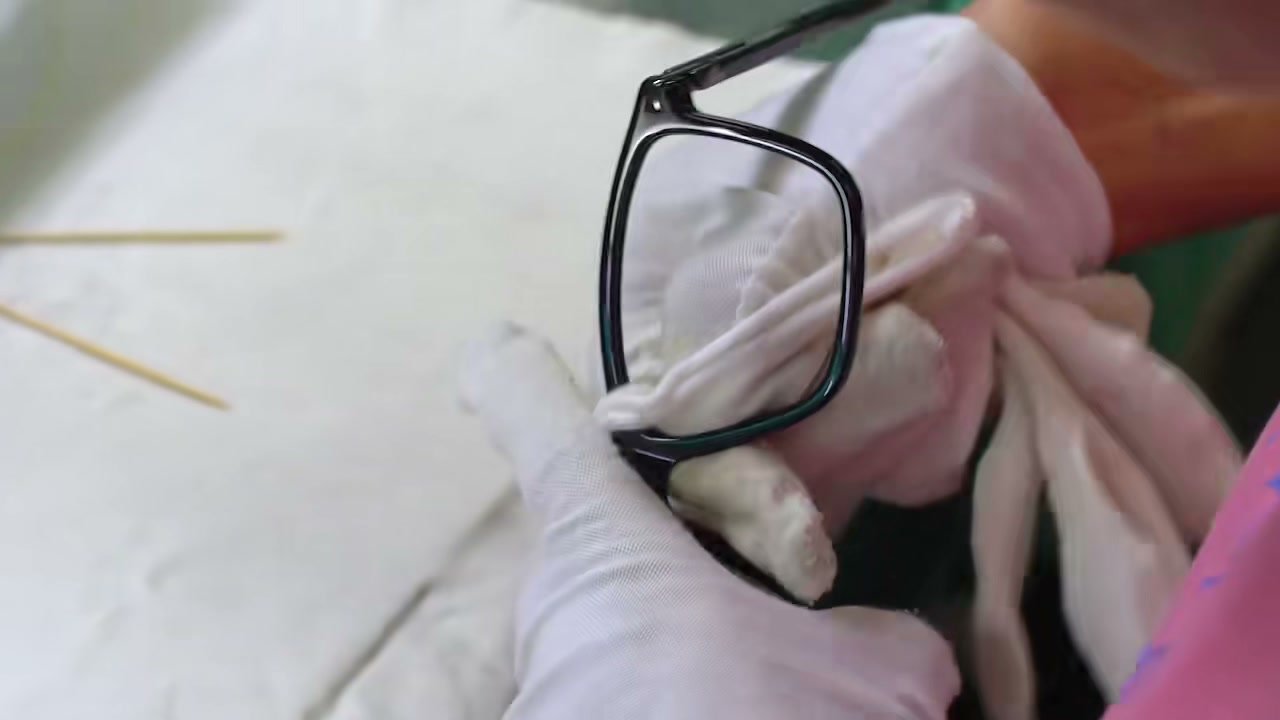
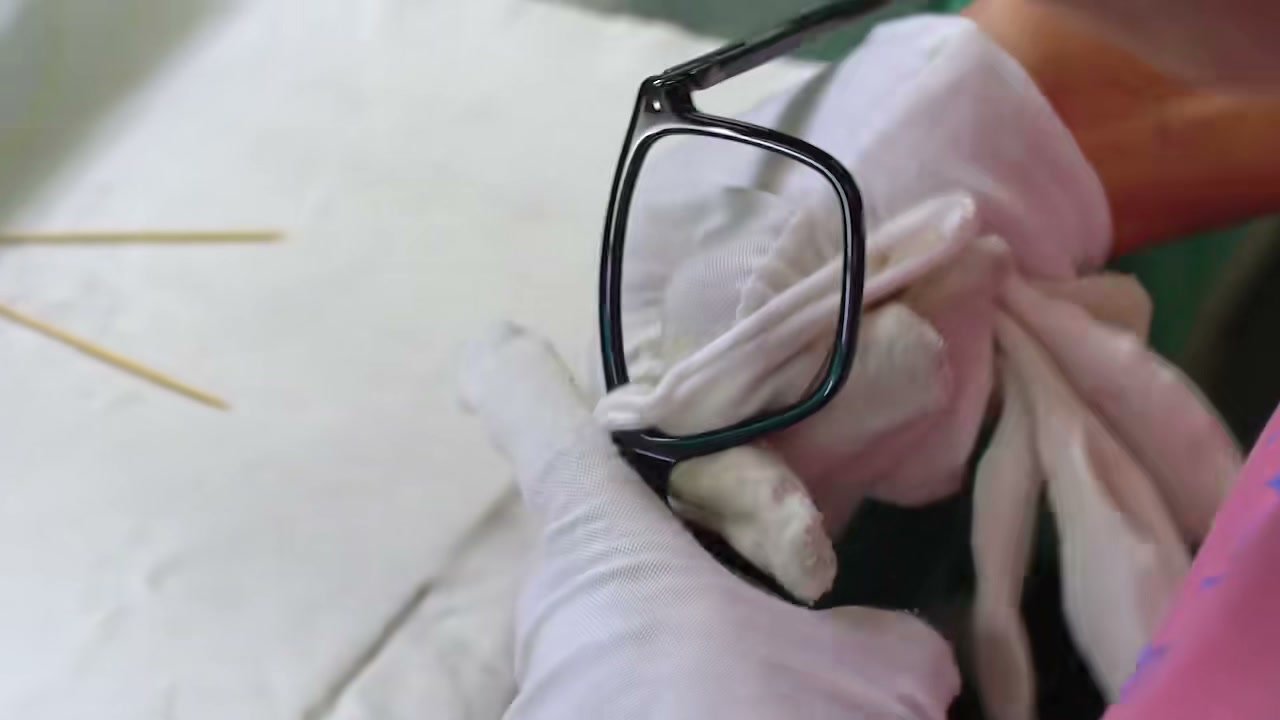
Review appearance, fit, assembly and packing against the agreed sample and project requirements.
What will the final review cover?
Own design or existing frame — the next step is a clear project brief.
Talk through your project05 / THE MATERIAL LIBRARY
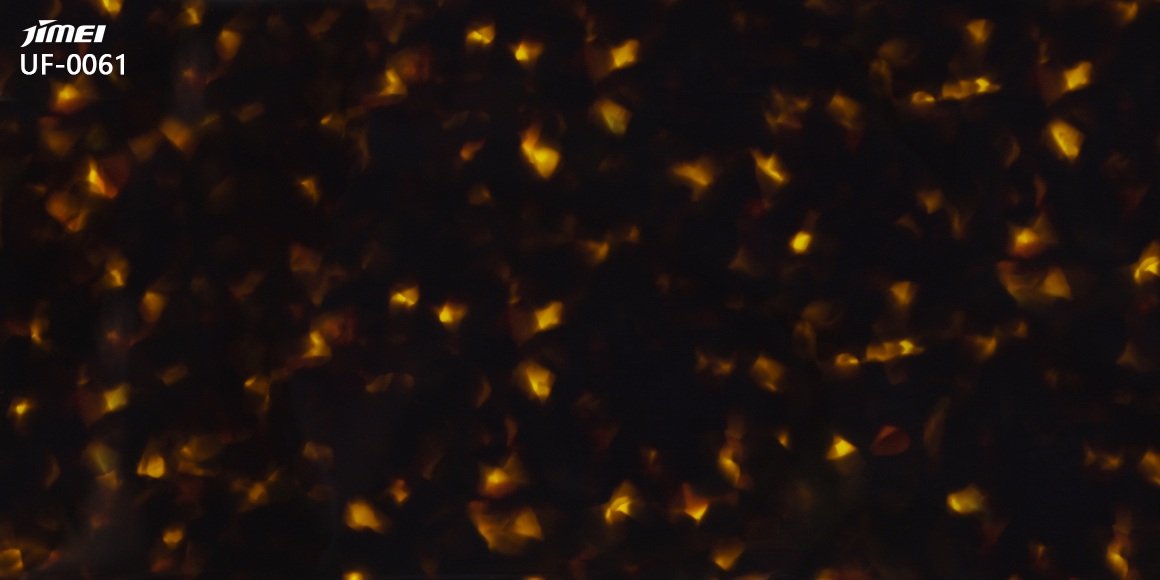
Material family
Sheet references
Screen colours are a guide. The actual sheet, pattern placement and availability are confirmed with a physical sample.
110 acetate sheets across 12 families, held as physical stock. Pick a frame, choose a sheet, and see how the pattern sits on the finished front.
Browse the full colour library06 / DESIGN DEVELOPMENT
01 / COLOUR & COLLECTION
Working with one double-bridge silhouette makes the colour decisions visible: the warmth of Havana, the contrast of ivory tortoise, or a restrained sand frame.
The six original samples pair different acetate and lens colours. Compare a direction here, then open the development record to view the original photographs and drawing.
Explore this colour series
Havana / Brown lens

02 / DESIGN & FEASIBILITY
The archived study compares two routes: keep the original shape and review the lens construction, or revise the contour around the intended lens. Physical fronts make that decision tangible.
Read the design decision
03 / EXISTING-FRAME DEVELOPMENT
Front, temple and three-quarter views help define what to keep and what to develop: the silhouette, colour palette, lens direction and branding position.
Explore the frame references06 / CONSTRUCTION & DETAIL
Explore the details that shape the feel, movement and identity of your acetate frame. Select a component to look closer.
 Schematic illustration · not to scale
Barrel hinges
A compact joint between front and temple. Compare the barrel layout and mounting method with the frame geometry.
DETAILS TO CONFIRMFrom component to frame.
Hinge connection · Original A10971 sampleIllustrated construction options. Availability, dimensions and finishes are confirmed for your frame.
07 / THE COLLECTION, COMPLETED
A case, a cloth, a box. Build a presentation that belongs with the frame. Browse the components, then add the ones you want to discuss to your project.
PACKAGING STUDY / ILLUSTRATION
Six components, considered together. Physical sample photography will be added here.
No packaging components added yet.
Review your project briefConnect each component to the frame, colour and order.
Check logo placement, model data and label content.
Review the folded frame, case lining and presentation together.
Confirm the approved pack and the carton identification.
08 / RECORDS YOU CAN REVIEW
Seven documents, each answering a different question. A report applies to the samples and criteria it names — these are named-sample records, not blanket certification for every frame or material.
 01SGSSGS ASSESSMENTProduction assessment494977479_P+T
 02SGSSGS ASSESSMENTCompany assessment492219067_T
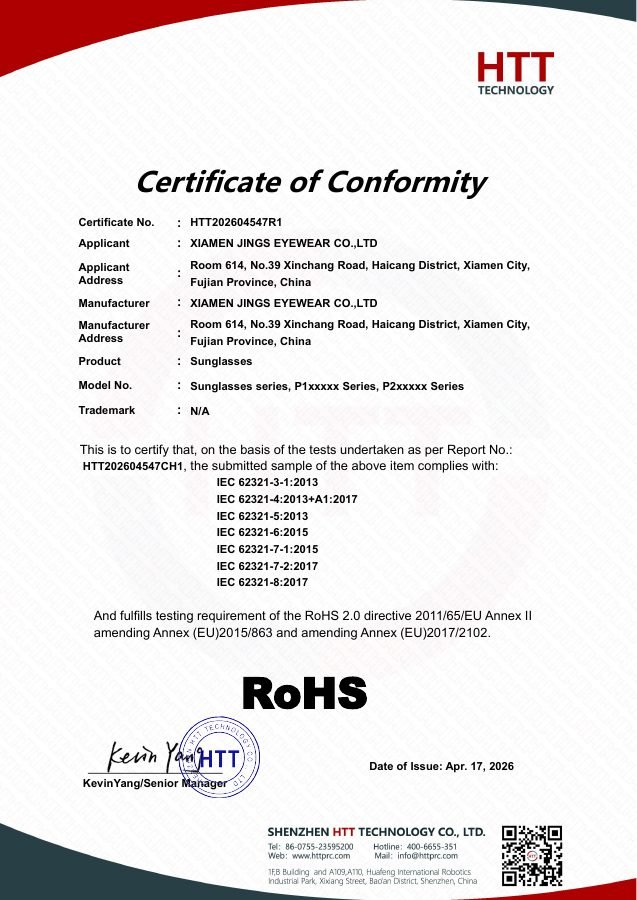 03PDFTEST REPORTEU RoHS conformityHTT202604547CH1
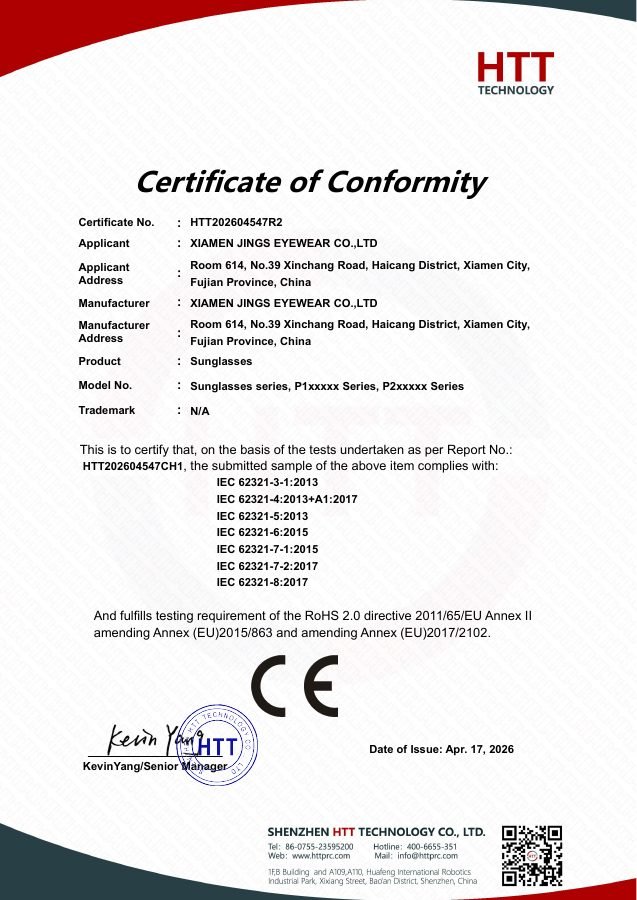 04PDFTEST REPORTEU RoHS conformity IIHTT202604547CH2
 05PDFTEST REPORTEU RoHS test reportHTT202604547CH1
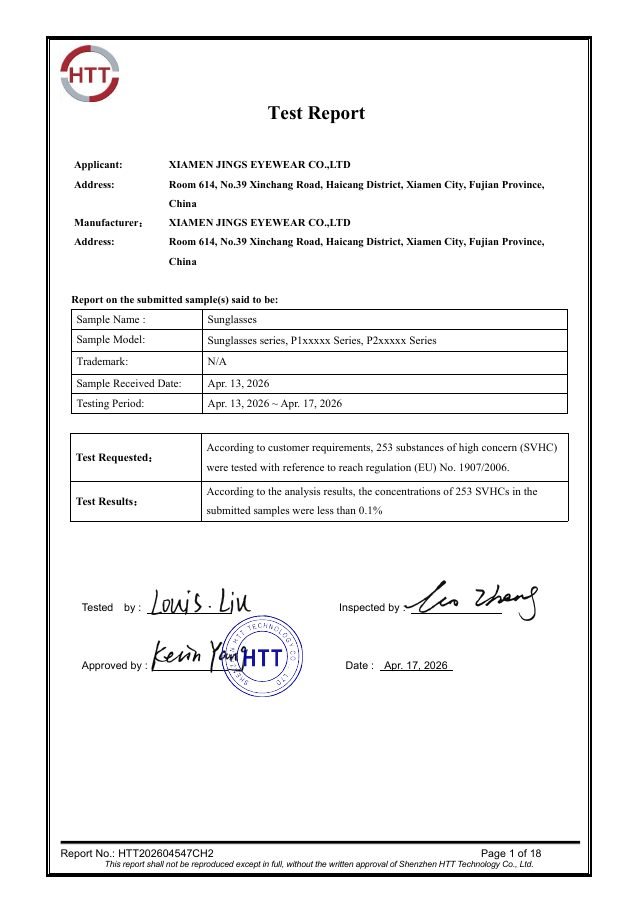 06PDFTEST REPORT253-SVHC test reportHTT202604547CH2
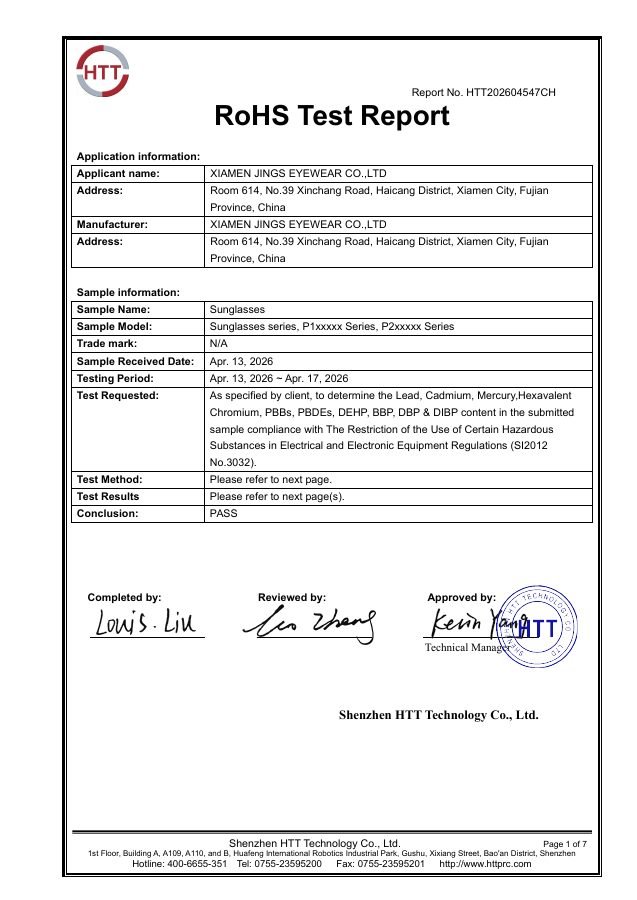 07PDFTEST REPORTUK RoHS test reportHTT202604547CH
SGS ASSESSMENT
Affiliated production unit of Xiamen Jings Eyewear. Covers the manufacturing site, its process scope and the products assessed.
Named sample scope: Sunglasses series / P1xxxxx / P2xxxxx, as specified in the reports. These are not blanket certifications for every frame or material.
Reserved for approved inspection sheets, sample sign-off records, batch traceability examples and corrective-action documentation.
09 / INSIDE THE PROCESS
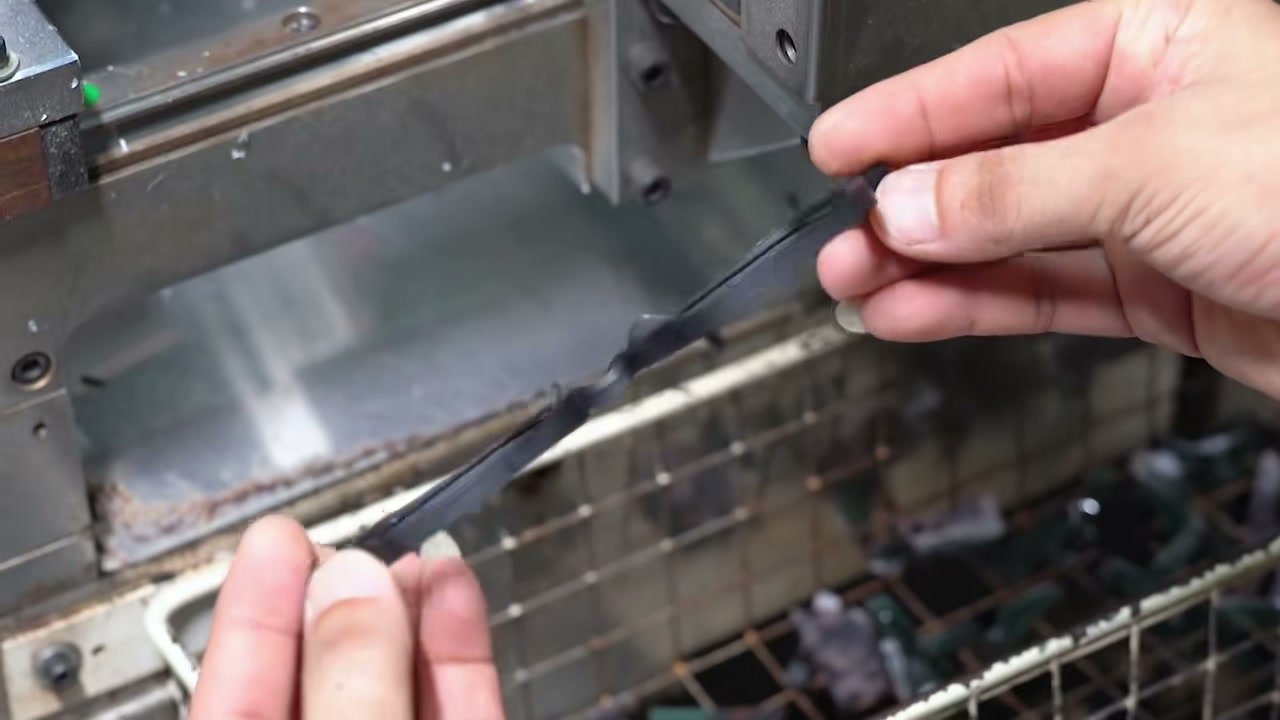
Six views from the supplied workshop photographs and factory film. Open a record for a closer look at the material, machines and assembly work.
CLIENT PERSPECTIVES
Names, companies, reviews and ratings are fictional placeholders. This layout is built to accept live Trustpilot or Google Business Profile data later.
Excellent
4.7 out of 5
Based on 6 reviews
Reviews collected from client projects and shown here as a design preview.
Source: placeholder
Founder & Creative Director · Aster Vale Eyewear
The acetate colours were easy to compare, and the team turned our references into a clear sample brief. Every revision had a purpose.

Product Development Manager · Orin & Vale Optical
Clear drawings and side-by-side sample updates helped us make decisions quickly. Small fit and branding details were resolved before we approved the sample.

Brand Director · Maison Veyra
The frame colours, logo placement and packaging felt like one collection. We especially valued having practical options to discuss at each review.

Head of Sourcing · Northline Atelier
The team made hinge and temple options easier to understand. Reviewing those details together gave us a clearer specification for the sample.

Collection Designer · Solenne Studio
We could compare the case, cloth and logo placement as one set. That helped us keep the packaging consistent with the frame direction.

Co-founder · Eastwell Eyewear
Each sample update made the next decision clear. We could review the fit, acetate colour and finishing notes without losing track of earlier changes.
No reviews match this filter.
Ready to connect live reviews? This section is structured to swap the placeholder source for Trustpilot or Google Reviews without a layout change.
Talk to our team11 / YOUR NEXT COLLECTION
Start with the frame, material or idea that brought you here. Your selections on this page stay together in one project brief.
YOUR SAVED REFERENCES
Xiamen Jings Eyewear Co., Ltd.Building 1-614, No. 39, Xinchang Road, Haicang District, Xiamen, China
Planning a visit? Contact our team to arrange a time.
QUESTIONS
300 pieces per style and colour. Quantities for several styles are confirmed together in your project brief, and tooling or packaging minimums are quoted alongside the frame specification. A reorder against an already approved sample uses the same minimum, so the first order defines the pattern for later production runs.
We are an acetate eyewear manufacturer based in Xiamen, with development and production coordinated by the same team rather than passed between offices. Our affiliated production unit is covered by an SGS production assessment, and the company itself by a separate SGS trade assessment, so the two records can be checked independently.
Five layers: frame shape, acetate colour, lenses, logo and branding, and packaging. Each layer is specified separately on the drawing, then reviewed together against one approved physical sample before production starts. This order matters because a lens or logo decision can change how the frame edge reads.
Send a drawing, a reference frame or a colour direction together with your target quantity and destination market. We reply with the frame and colour options that fit, then agree a technical drawing and quotation before any sample is produced. A complete first message removes several review rounds.
110 sheet references across 12 material families, held as physical stock for sampling. Constructions are extruded, block and laminated, and the construction affects how colour reads at the frame edge: extruded is consistent through the thickness, while block and laminated reveal pattern on the cut surface.
Yes. ODM development starts from your sketch, technical drawing or reference sample. We work through the shape, fit and colour on a drawing first, then produce a physical sample for your approval before any production tooling is committed. Revisions are cheaper at the drawing stage than after sampling.
Two SGS assessments and five test reports: EU RoHS conformity, EU RoHS test, UK RoHS and 253-SVHC. Each record names the samples and criteria it applies to, so you can check whether a report covers the frame or material you are ordering rather than assuming blanket coverage.
No. The named-sample scope is stated on each report. A test report applies to the samples and criteria it identifies, not as a blanket certification for every frame or material. Confirm applicability to your specific model and components before relying on a record for compliance.